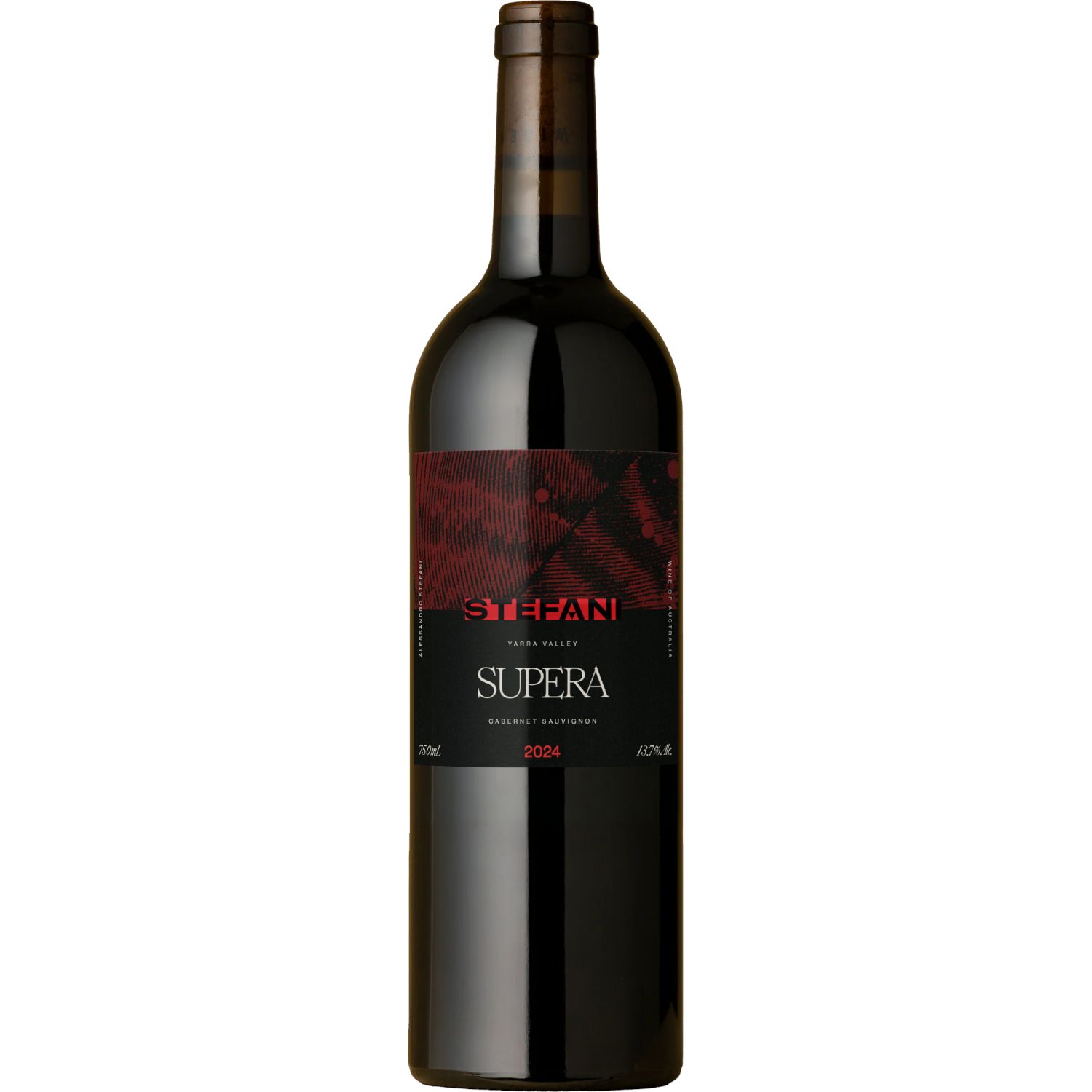

The colour suggests considerably more body than what arrives on the palate: deep, purple edged, then suddenly lifted red and blue fruit, juice, chalk, tannin further back. No heavy black-fruit mass, no wall of oak, none of the severity Cabernet can so easily acquire. It is sensuous, usually not a word I’d place next to Cabernet.
And this may be Alessandro’s most interesting argument for the Yarra Valley.
Cabernet has a long history here, yet Pinot Noir and Chardonnay eventually became the region’s louder modern identity. Ale thinks we may have overlooked a grape that was already extraordinarily comfortable in the place. His Cabernet block gives us that evidence. It sits low near the entrance to the property on old Devonian-derived clay and rock with more topsoil than the steeper parcels; the vines barely make it to the wire in places, the canopy tiny, yields naturally modest, berries thick-skinned. It is also one of his least troublesome blocks under organic farming and can get away with fewer organic sprays than more disease-sensitive varieties.
His farming follows that observation. Stefani deliberately keeps canopies small and removes leaves early, just after flowering, exposing young berries to the sun while their skins are developing rather than suddenly exposing them later in summer. In a low-yielding Yarra vineyard, he questions the Australian instinct to carry enormous canopies: more humidity around the fruit, more disease pressure, more leaf relative to crop pushing sugar while flavour is still catching up. What he wants is flavour maturity while the acidity remains high and sugars relatively restrained.
The Cabernet arrives in the winery with thick skins and plenty of structure already built in, so again he doesn’t go looking for more. Whole berries, a little intracellular fermentation, around 35 days on skins, long contact but measured extraction. His preference is almost always time rather than force.
The result is Cabernet on a different set of proportions. Medium-bodied, juicy, red and blue rather than black, with this chalky middle that keeps interrupting the fruit just as it begins to take over. That chalkiness is important; without it the wine could become too simply delicious, but the resistance keeps pulling you back into it to find more notes underneath.
It isn’t Coonawarra or Margaret River. It doesn’t have the dark graphite and Kalamata register I find in some central Victorian Cabernet either. Alessandro talks about old Claret, before Cabernet became synonymous with weight and extraction. This wine is built to drink while young and still capable of ageing.
You can feel Burgundy in Alessandro’s palate, although nothing here tastes Burgundian. It is more fundamental than that: the belief that perfume can still carry seriousness, that acidity and tannin can provide longevity without density, that a wine can be delicious immediately and still give a sommelier something to think about.
This is how I want to drink Cabernet Sauvignon.

Liinaa Berry is a Melbourne-based wine critic and consultant with over a decade of experience as a sommelier and wine buyer across Australia and around the world where she has built award-winning wine programs and championed independent producers with conviction. Now focused on reviewing and writing, Liinaa brings a floor-trained palate and commercial insight to her assessments. She is also the Melbourne Ambassador for Star Wine List and serves on the committee of Sommeliers Australia. An advocate for site-driven wines and thoughtful farming, Liinaa is particularly drawn to producers who articulate a clear sense of place. Her tasting philosophy centres on structure, balance and context — always asking not just how a wine tastes, but why it matters.